
Bone Density After Menopause: What Actually Helps
Bone density is the only midlife health issue I know of where you can lose a decade of ground and feel absolutely nothing.
No symptom. No twinge. No moment where your body tells you something has changed. You find out one of two ways: a scan, or a fall in the car park at Woolworths that turns into a broken wrist and a very long year.
Around your final period, bone loss accelerates sharply. In SWAN, the study that has tracked women through the menopause transition for decades, the spine loses about 2.5% a year in the window from one year before the last period to two years after. The hip loses around 1.8%. Over roughly six years, that's about 10% of your spine.
The Australasian Menopause Society puts it plainly: the average woman loses up to 10% of her bone mass in the first five years after menopause.
And nobody mentions it, because there's nothing to mention. It doesn't hurt.
The short answer
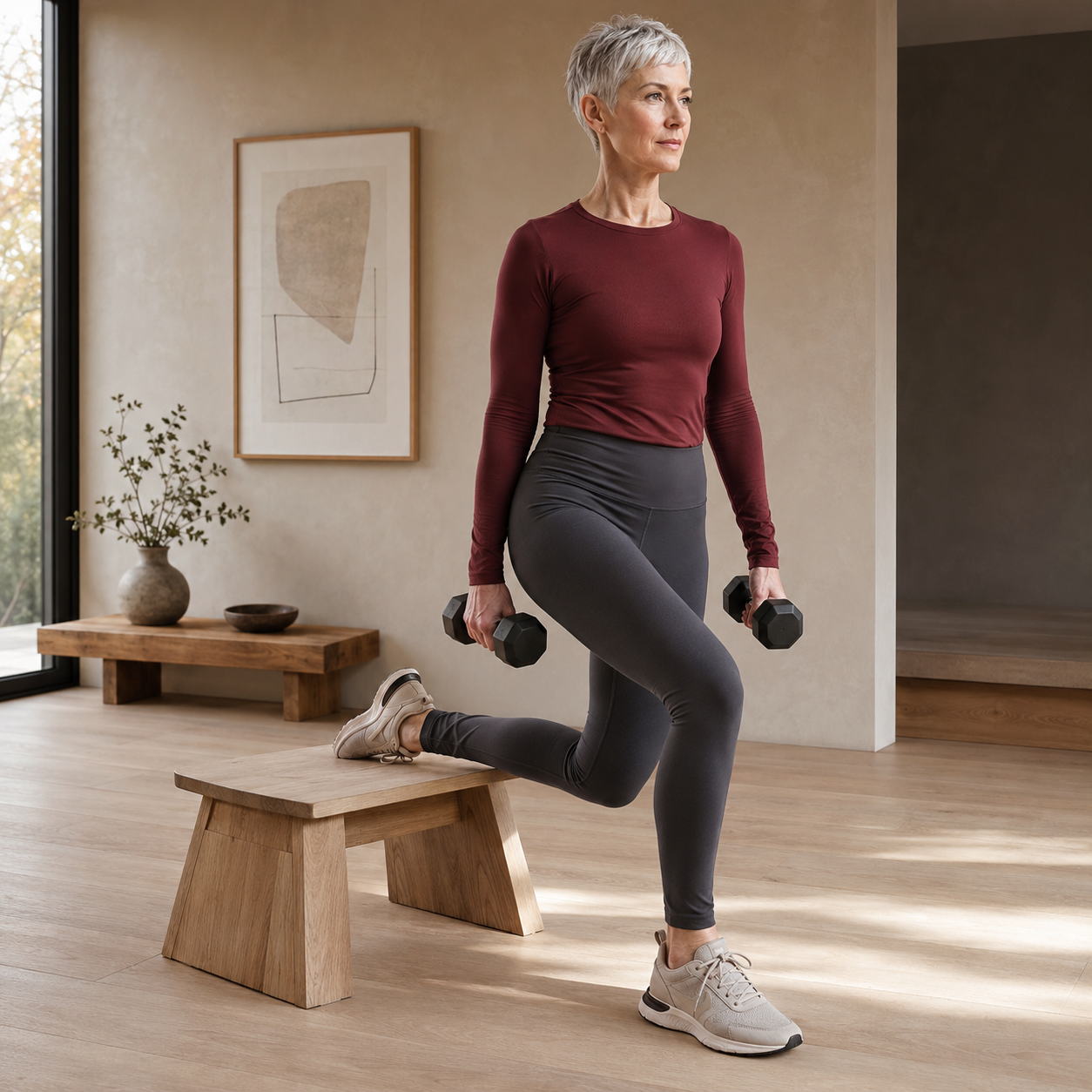
Lifting heavy things is the intervention with the best evidence. An Australian trial had postmenopausal women with low bone density deadlifting and squatting at over 85% of their maximum, twice a week for 30 minutes. Spine density rose 2.9% while the control group lost 1.2%. There were no fractures.
Walking does not build bone. A meta-analysis of ten trials found no significant effect at the spine, wrist or whole body. Walk for your heart and your head, not your skeleton.
Most fractures don't happen to women with osteoporosis. In an Australian study, 56.5% occurred in women with osteopenia, the "mild" category nobody treats.
And Medicare won't rebate a bone scan for a healthy 52-year-old. That gap is worth knowing about before you ask.
How big is this, really
Bigger than almost anyone realises, and the numbers depend entirely on how you count.
Ask how many Australians have poor bone health and the answer, from Deakin University's burden-of-disease modelling, is 6.29 million people over 50 - around 67%. Of women over 50, roughly 3.49 million have osteoporosis or osteopenia.
Ask how many know, and the AIHW figure, based on self-report - is 3.4%.
That gap is the whole story. Most Australian women with thinning bones have never been scanned and have no idea.
Meanwhile: 193,482 fractures a year, projected to reach 237,632 by 2033. That's a broken bone every 2.2 minutes. Women break their wrists 7.9 times more often than men, their spines 3.4 times more often, their hips 2.4 times more often.
From age 60, the residual lifetime risk of a fragility fracture for an Australian woman is 44%. For a woman who already has osteoporosis, it's 65%.
And hip fractures are not broken bones in the ordinary sense. Twelve-month mortality after hip fracture surgery in NSW is 25.3%. More than one in ten people are discharged straight into aged care. Fewer than half are walking as well as they were a year later.
I'm not writing that to frighten anyone. I'm writing it because "osteoporosis" sounds like a word for old ladies, and 25% mortality is not a word for old ladies. It's a serious medical event that begins, silently, in your forties.

The bit that will change how you think about this
Ask most people who gets fractures and they'll say women with osteoporosis. That's the diagnosis, so that must be the risk.
The Geelong Osteoporosis Study followed 616 postmenopausal women and found that 56.5% of fractures happened to women with osteopenia, the in-between category that gets a shrug and a "keep an eye on it." Only 26.9% happened to women who'd actually been diagnosed with osteoporosis.
Both things are true: an individual woman with osteoporosis is at much higher risk, and most broken bones happen to women who don't have it. There are simply far more women in the osteopenia category.
So if you've ever been told you have "mild bone thinning, nothing to worry about" - that's the group where the majority of Australia's fractures come from.
The exercise question, settled
This is where the evidence is genuinely strong, and where the standard advice given to women is genuinely wrong.
Walking doesn't build bone
A meta-analysis of ten trials found walking had no significant effect on bone density at the lumbar spine, the radius or the whole body. A 2025 network meta-analysis of 49 trials and 3,360 postmenopausal women reached the same conclusion, walking wasn't significant at the spine or the femoral neck. Neither was tai chi.
Walking is wonderful. It's good for your heart, your mood, your blood sugar and your balance, and better balance means fewer falls, which means fewer fractures. Keep walking.
It just isn't a bone-density strategy, and telling women it is has cost a lot of them a lot of years.
What does work: LIFTMOR
This trial came out of Griffith University, led by Professor Belinda Beck, and it's the one I'd want every woman over 45 to know about.
They took 101 postmenopausal women, average age 65, all with osteopenia or osteoporosis. Half did eight months of high-intensity resistance and impact training: twice a week, 30 minutes, five sets of five reps at over 85% of their one-rep maximum. Deadlifts. Overhead press. Back squats. Jumping chin-ups with drop landings.
Yes, women in their sixties with thinning bones, deadlifting near their limit.
| Outcome over 8 months | Heavy training | Control |
|---|---|---|
| Lumbar spine bone density | +2.9% | −1.2% |
| Femoral neck bone density | +0.3% | −1.9% |
| Height | +0.2cm | −0.2cm |
| Back extensor strength | +36% | +11% |
| Leg extensor strength | +35% | +8% |
They got taller. Postmenopausal women with low bone mass got measurably taller over eight months, because their spines stopped compressing.
And the safety result, which is what everyone actually wants to know: across the whole trial there was one adverse event, a minor low-back muscle strain. No fractures. Compliance in the heavy-lifting group was 92%, higher than the gentle home-exercise control group.
Thirty minutes, twice a week. An hour a week to reverse the direction of your spine.
Australia's own guideline agrees, incidentally. The 2024 RACGP and Healthy Bones Australia guideline says resistance training should be "at least twice a week, moderate to vigorous, and progressive," alongside weight-bearing impact on most days and genuinely challenging balance work.

Getting scanned and the Medicare trap
A DEXA scan takes about ten minutes and tells you where you stand. A T-score above −1.0 is normal, between −1.0 and −2.5 is osteopenia, and −2.5 or below is osteoporosis.
Here's the part that catches women out. Medicare does not rebate a bone density scan for a healthy woman under 70. An application to extend the rebate to women aged 60–69 was assessed in 2024 and not supported, deemed not cost-effective.
You get a rebated scan if you've had a fracture from minor trauma, if you've been on significant steroid doses, if you went through menopause before 45, or if you have coeliac disease, chronic kidney or liver disease, rheumatoid arthritis, hyperparathyroidism or thyroxine excess. Otherwise, under 70, you pay.
Worth knowing: a parent's hip fracture, recurrent falls, low body weight and aromatase inhibitors are all real risk factors that attract no rebate at all. The clinical risk factors and the funding rules don't line up.
Start with a free tool instead. Know Your Bones is an online self-assessment built by Healthy Bones Australia and the Garvan Institute. Five to ten minutes, and it produces a report you can take to your GP. That's a far better conversation-opener than "should I get a scan?"
See your GP about your bones if any of these apply:
- You've broken a bone from a fall from standing height or less, after 50
- Menopause or ovarian insufficiency before 45
- Long-term corticosteroids, aromatase inhibitors or androgen deprivation therapy
- You've lost height, or noticed a stoop, or have new back pain
- A parent had a hip fracture
- BMI under 20, or significant unintended weight loss
- Coeliac disease, IBD or bariatric surgery
Calcium, vitamin D and the supplements question
Calcium. The Australian RDI rises at 50, from 1,000mg a day to 1,300mg - because more calcium is lost in urine after menopause and absorption drops. Australian adults over 50 average about 800mg, and only around 10% of older women hit the target from food alone.
Food first. If you're falling short, Healthy Bones Australia recommends a supplement of 500–600mg, topping up the gap, not replacing the whole requirement. The cardiovascular scare from a decade ago has largely been walked back for doses in that range, though some cardiologists still dissent on the methodology. Mega dosing was never the recommendation and still isn't.
Vitamin D. Target a blood level above 50 nmol/L, measured at the end of winter when it's lowest. More than one in five Australian adults falls below it. If you're deficient, 800–1,000 IU a day is the recommended dose.
Two Australian trials are worth knowing about here. One gave women over 70 a single annual megadose of 500,000 IU, and produced 15% more falls and 26% more fractures than placebo. The other, D-Health, gave 20,000 Australians monthly vitamin D for five years and found no reduction in fractures at all.
Vitamin D corrects deficiency. It is not a bone-building supplement for people who aren't deficient, and mega doses are actively harmful. Get the blood test rather than guessing.
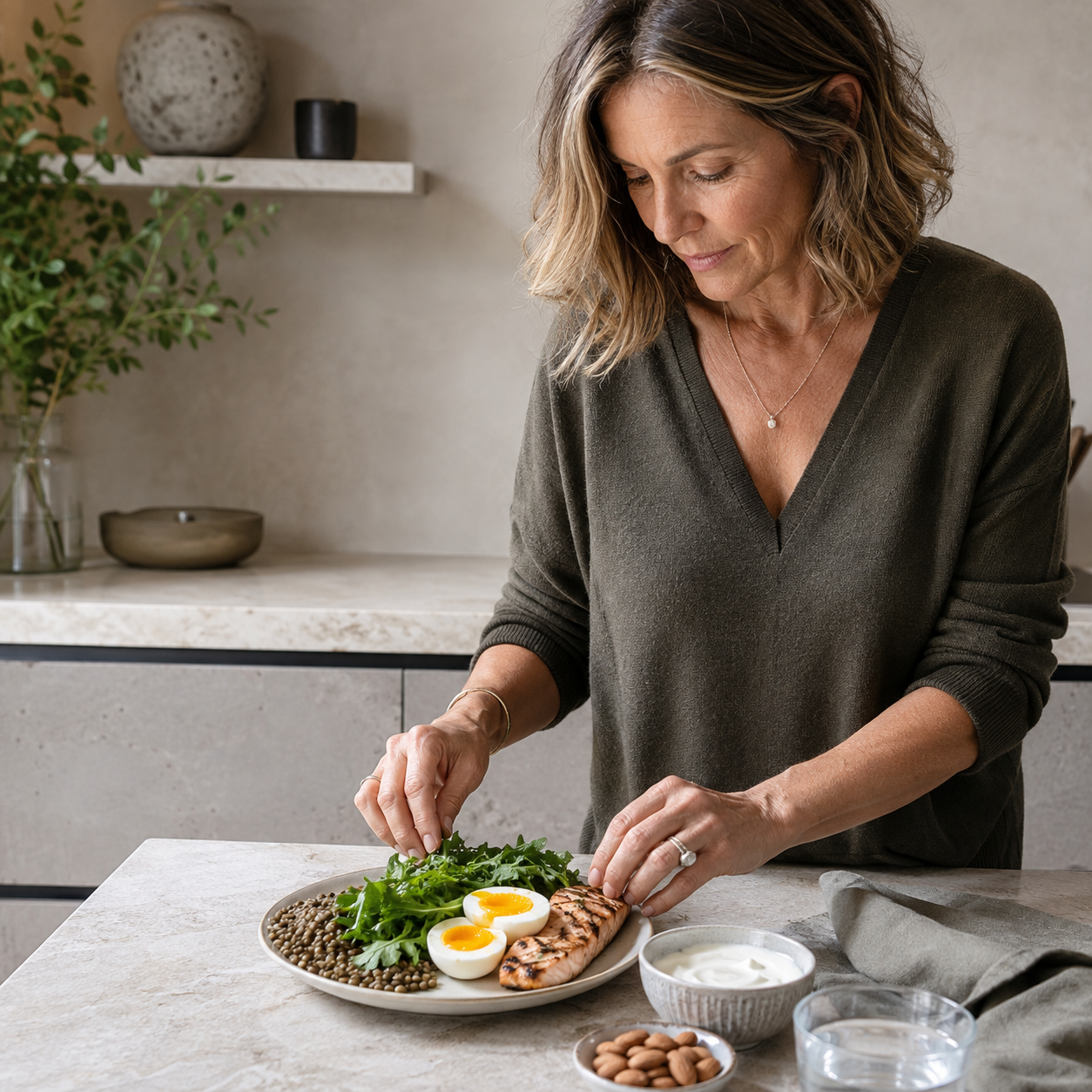
Protein. The old fear that protein leaches calcium from bone is dead , the ESCEO/IOF expert consensus states flatly that "there is no evidence that diet-derived acid load is deleterious for bone health," and that intakes above the current RDA are associated with higher bone density and slower loss, provided calcium is adequate. Their line is worth repeating: insufficient protein is the more serious problem in older adults. More on protein here.
What about collagen?
You'd expect me to oversell this. I'm not going to.
There is one decent trial: 131 postmenopausal women with low bone density, 5g a day of a specific collagen peptide, twelve months, placebo-controlled. Bone density T-scores improved significantly at both the spine and femoral neck versus placebo, bone formation markers rose, and resorption markers held steady while the placebo group's rose.
The caveats are real. The trial was part-funded by the manufacturer of the tested product. About 22% dropped out. The changes were small, T-score shifts of +0.1 and +0.09. The four-year follow-up everyone quotes involved just 31 women with no control group and no blinding, which makes it close to worthless as evidence. And no trial has shown a reduction in fractures.
Promising. Not established. Reasonable as an adjunct if you're already doing the things that work. Useless as a substitute for them. Our full collagen comparison is here, including which product contains that specific peptide at the studied dose.
Hormone therapy
This is genuinely GP territory, so I'll give you the facts and stop.
The Women's Health Initiative, 16,608 women, five and a half years found estrogen plus progestin reduced hip fractures by 33% and total fractures by 24%, with benefit across all subgroups, including women who weren't selected for osteoporosis. The Australasian Menopause Society puts the reduction in spinal and hip fractures at around 40%, with bone density rising roughly 5% over two years.
Australia's 2024 guideline gives this Grade A evidence for postmenopausal women within ten years of menopause, with the caveat that risks must be weighed against benefits individually.
One thing worth knowing that rarely gets said: bone loss resumes when you stop, and for the first four to five years afterwards it runs faster than normal. MHT protects your bones while you take it. It isn't a course of treatment that banks a permanent gain.
Things that don't work
Whole-body vibration plates. An overview of 15 systematic reviews concluded the evidence "cannot establish definitive advantages" and explicitly did not recommend them.
Isometric loading machines (the bioDensity / OsteoStrong-style systems). In the male arm of the LIFTMOR trials, the isometric group had five new thoracic vertebral fractures against zero in the heavy-lifting group. A 2025 pilot in 44 postmenopausal women found no improvement in bone density at the hip, femoral neck or spine after eight months.
Vitamin K2 alone. A meta-analysis of 16 trials found K2 on its own was not significant for lumbar spine density, and had no effect at the femoral neck.
Alkaline diets. Refuted. See the protein section.
So what would I actually do
Do the free assessment. Know Your Bones, ten minutes, print the report.
Take it to your GP and ask directly whether you qualify for a rebated scan, and if not, whether one is worth paying for given your risk factors.
Start lifting properly. Twice a week, thirty minutes, heavy and progressive, taught by someone who knows what they're doing. This is the single highest-return hour of your week and nothing else on this page comes close.
Get calcium from food, top up 500–600mg if you're short.
Get your vitamin D tested at the end of winter rather than guessing.
Eat enough protein. It helps, and it doesn't harm your bones.
The thing about bone is that it responds. It isn't a slow inevitable slide you have to accept, the LIFTMOR women didn't just slow their losses, they went the other way, at 65, in eight months, an hour a week.
You just have to load it. Properly. Gentle doesn't work, and nobody told us.
Frequently asked questions
How much bone do you lose after menopause?
Bone loss accelerates from about a year before your final period. SWAN data shows the lumbar spine losing around 2.5% per year during the transition and the femoral neck 1.8%, slowing to about 1.1% a year afterwards. The Australasian Menopause Society estimates the average woman loses up to 10% of her bone mass in the first five years after menopause.
What is the best exercise for bone density after menopause?
High-intensity progressive resistance training. The Australian LIFTMOR trial had postmenopausal women with low bone density perform deadlifts, squats, overhead press and jumping chin-ups at over 85% of their one-rep maximum, twice weekly for 30 minutes. Lumbar spine density rose 2.9% over eight months while a low-intensity control group lost 1.2%, with no fractures.
Does walking help osteoporosis?
Not for bone density. A meta-analysis of ten trials found walking had no significant effect on bone density at the lumbar spine, radius or whole body. Walking remains valuable for cardiovascular health, mood and balance, and better balance reduces falls, but it does not build bone.
Can I get a Medicare rebate for a bone density scan?
Only if you qualify. Rebated scans are available after a minimal-trauma fracture, for people on long-term corticosteroids, for menopause before 45, for certain medical conditions including coeliac and chronic kidney disease, and routinely from age 70. A healthy woman under 70 without these factors pays out of pocket. An application to extend the rebate to ages 60–69 was not supported in 2024.
Is osteopenia serious?
More serious than it sounds. Australian research found 56.5% of fractures in postmenopausal women occurred in women with osteopenia, compared with 26.9% in women with diagnosed osteoporosis. Individual risk is higher with osteoporosis, but most fractures happen in the osteopenia group because far more women are in it.
Does collagen help bone density?
The evidence is promising but limited. One 12-month randomised placebo-controlled trial in 131 postmenopausal women found 5g daily of a specific collagen peptide significantly improved bone density T-scores at the spine and femoral neck. The trial was part-funded by the manufacturer, changes were small, and no trial has demonstrated reduced fractures. Reasonable as an adjunct; not a substitute for resistance training.
How much calcium do women over 50 need?
The Australian RDI is 1,300mg daily for women over 50, up from 1,000mg. Australian adults over 50 average around 800mg and only about 10% of older women reach the target from food alone. Aim for food first; if you fall short, a 500–600mg supplement is the recommended top-up.
Does HRT protect bones?
Yes, while you take it. The Women's Health Initiative found oestrogen plus progestin reduced hip fractures by 33% and total fractures by 24%. Bone loss resumes when treatment stops, and runs faster than normal for the first four to five years afterwards. Whether MHT is appropriate depends on individual history, a decision for your doctor.
This article is general information, not medical advice. Bone health decisions, including scans, supplements, hormone therapy and starting resistance training with known osteoporosis, should be made with your GP.






Leave a comment
This site is protected by hCaptcha and the hCaptcha Privacy Policy and Terms of Service apply.